


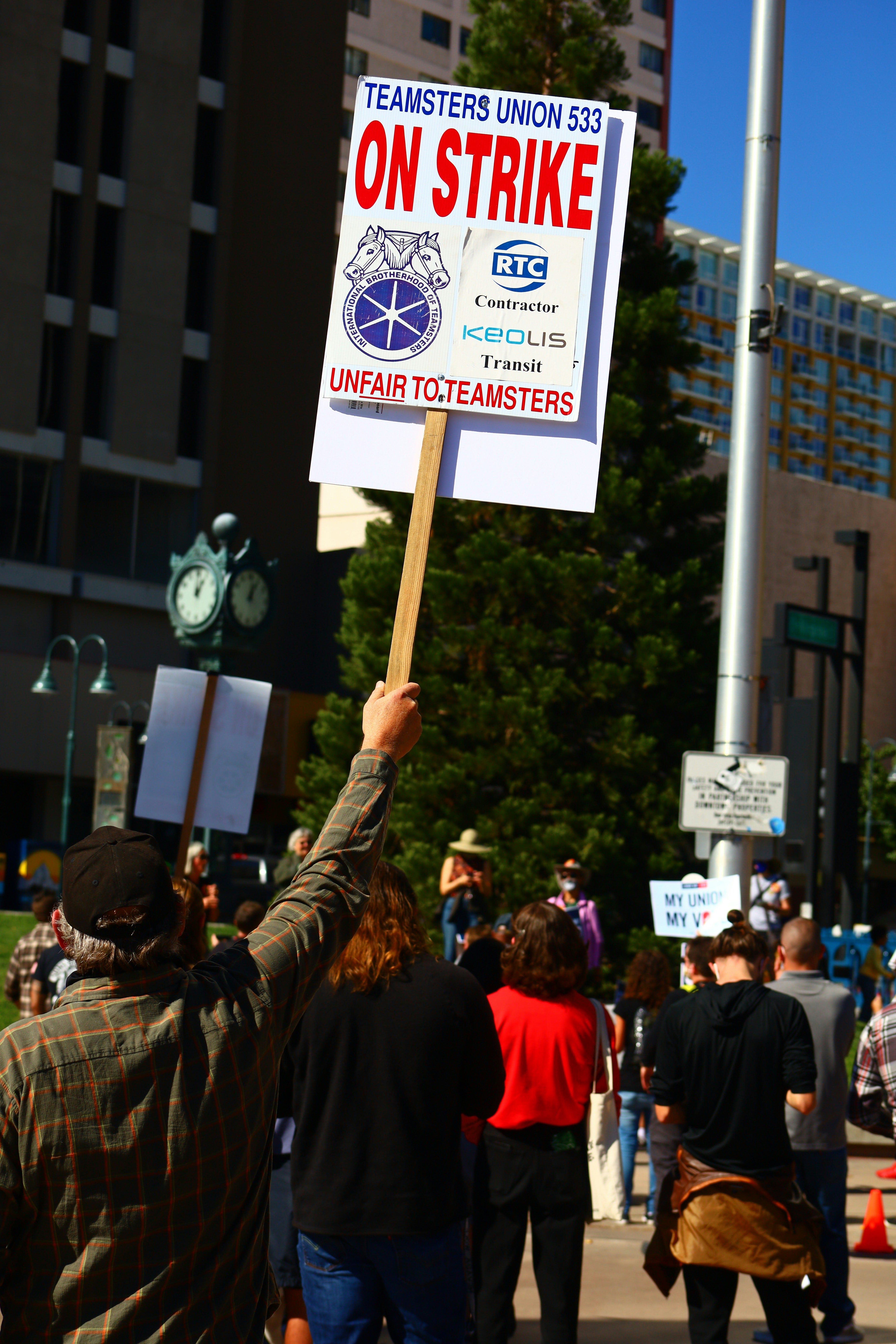
For the last three years, I have become increasingly curious about labor unions for a very practical reason: apparently I cannot go to Europe without somebody going on strike.
Train workers. Taxi drivers. Airport workers. General strikes. At some point during nearly every trip, someone announces they are not working today because they would like better pay, better benefits, a better retirement age, or simply because they are French and it is Tuesday.
And inevitably, some part of our trip gets rearranged.
At first, it was frustrating. Then I started paying attention.
Because we rarely experience labor power like that in Texas. We don’t routinely see workers collectively stopping an entire industry and forcing government leaders and corporations to negotiate.
So I started wondering: Why does labor have so much power in some countries, while American workers, and particularly Texas workers, have so little?
How we got here.
First, Labor Day Was Actually About Labor
Labor Day became a federal holiday in 1894, but by then roughly 30 states were already celebrating it. The holiday grew out of the labor movement, with organizations including the Central Labor Union and Knights of Labor promoting celebrations and worker demonstrations.
One of the first major Labor Day celebrations was held in New York City in 1882 and included a parade. And if you know anything about New York City, you know they have never needed much convincing to have a parade.
But Labor Day wasn’t created because Americans desperately needed one final opportunity to buy a discounted mattress before fall.
It came from a period when American workers were organizing for something we take for granted today: power.
Power over their wages. Power over their hours. Power over their safety. Power over whether their children had to work. Power to negotiate collectively instead of walking individually into the boss’s office and hoping he was feeling generous.
And organized labor helped fundamentally change American life.
A Lot of Things We Consider “Normal” Were Once Radical
The eight-hour workday wasn’t always normal.
The 40-hour workweek wasn’t normal.
Overtime wasn’t normal.
A minimum wage wasn’t normal.
Workplace safety regulations weren’t normal.
Restrictions on child labor weren’t normal.
Workers had to organize and fight politically for those protections.
The Fair Labor Standards Act of 1938 eventually established federal minimum-wage, overtime, and child-labor standards. The labor movement had spent decades pushing for shorter working hours and better working conditions.
So when someone receives time-and-a-half for overtime today, that isn’t because corporate America collectively decided workers deserved a little something extra.
It’s because workers fought for it.
Organized labor was also part of broader political coalitions that helped push America toward unemployment insurance, Social Security, workers’ compensation, workplace safety laws, and eventually family and medical leave.
And unions didn’t only change laws.
Collective bargaining helped normalize things such as weekends and shorter workweeks, paid vacations, paid holidays, employer health insurance, pensions, seniority protections, grievance procedures, workplace safety rules, and more predictable schedules.
Not all of those became legal rights. In fact, America still does not have a federal law guaranteeing workers paid vacation.
But when unionized employers offered better compensation and benefits, other employers had to compete for workers.
That is an important part of this story.
Unions didn’t just increase the bargaining power of union workers. They helped increase expectations for American workers.
Then America Started Changing the Rules
The modern era of American organized labor really begins with the Wagner Act of 1935, formally the National Labor Relations Act.
It protected the right of most private-sector workers to organize, form unions and bargain collectively, and it created the basic federal framework we still use today.
Union membership grew dramatically during the following years.
And then came the backlash. It’s always the backlash!
1947: Taft-Hartley
If you want to understand what happened to American union power, remember one name: Taft-Hartley.
In 1947, a Republican-controlled Congress passed the Labor Management Relations Act over President Harry Truman’s veto.
Taft-Hartley didn’t abolish unions.
It did something much more consequential.
It limited many of the tools unions could use to exercise power.
The law outlawed closed shops, restricted secondary boycotts, excluded supervisors from bargaining units, created additional unfair-labor-practice provisions applicable to unions, established mechanisms for workers to decertify unions, and imposed other restrictions on union activity.
But perhaps most consequentially for Texas, Section 14(b) allowed states to adopt what we now call right-to-work laws.
And Texas wasted approximately zero time.
Texas Goes Right-to-Work
Texas became a right-to-work state in 1947. Just a few weeks after the Taft-Hartley.
The argument was framed around individual freedom: workers shouldn’t be forced to join or financially support a union as a condition of employment.
Supporters also argued right-to-work would make Texas more attractive to employers and promote economic development.
Opponents argued it created a structural problem for unions: workers could receive benefits negotiated by a union while choosing not to financially support it, weakening the institution responsible for bargaining.
Texas business interests embraced the new model, including oil and manufacturing interests and, at the time, conservative Democrats.
Yes, Democrats.
Texas politics used to be wildly different. (look up Dixiecrats)
Over the following decades, Texas built an economic-development strategy around low taxes, lower regulation, flexible labor markets and relatively weak organized labor.
And that strategy worked in one very important sense: Texas experienced extraordinary economic and population growth and became extremely attractive to businesses.
But there is another side of that equation.
What is good for attracting corporations isn’t automatically good for the bargaining power of the people working for them.
The Restrictions Kept Coming
In 1959, Congress passed the Landrum-Griffin Act. Parts of the legislation responded to legitimate concerns about corruption and internal union governance and established important protections for union members.
But it also further restricted union tactics, including secondary boycotts, certain picketing and so-called “hot cargo” agreements.
So look at the trajectory.
1935: The federal government protects workers’ ability to organize.
1947: Congress substantially restricts some of labor’s most powerful economic tools.
1959: Congress adds another layer of restrictions.
Then the American labor system gets even more complicated because public employees aren’t governed by exactly the same rules.
States developed their own systems governing teachers, firefighters, municipal workers, and other public employees.
Which brings us back to Texas.
Texas Put Even More Limits on Public Workers
Texas heavily restricts collective bargaining for many public employees. Teachers and many state and municipal employees do not have the broad collective bargaining rights available to workers in some other states.
Texas also prohibits public employees from striking.
Think about how significant that is.
A French transportation worker can participate in a strike that brings trains to a halt.
A Texas public school teacher cannot legally say, “Enough. We’re all walking out tomorrow.”
Texas has also limited local governments’ ability to enact certain labor protections, restricted some public-sector union mechanisms, maintained relatively weak prevailing-wage structures compared with heavily unionized states, and embraced employment structures involving contracting and subcontracting that can make traditional workplace organizing more difficult.
Texas didn’t accidentally end up with weak organized labor.
We made policy choices.
Then Ronald Reagan Sent America a Message
In 1981, members of the Professional Air Traffic Controllers Organization, PATCO, went on strike.
The strike was illegal under federal law.
President Ronald Reagan ordered them back to work. When thousands refused, his administration fired more than 11,000 striking controllers.
This wasn’t a new anti-union law.
But it was culturally enormous.
It demonstrated that the federal government was willing to take an extraordinarily hard line against a major union.
Corporate America noticed.
Organized labor noticed.
Everybody noticed.
And Then Came Janus
In 2018, the Supreme Court decided Janus v. AFSCME.
The Court held that public employees who choose not to join a union cannot be required to pay agency fees to that union.
Again, the question is bigger than whether someone should be required to pay union fees.
It’s about the structure of collective bargaining.
The union may still represent workers in the bargaining unit, including nonmembers, while those workers cannot be compelled to financially support it.
That further changed the financial structure of public-sector unionism across America.
But There Is Another Problem: America Changed, and Labor Law Didn’t
This may be one of the most overlooked pieces of the entire story.
The American economy of 2026 looks nothing like the American economy of 1935.
We now have gig workers, subcontractors, franchises, staffing companies, independent contractors, enormous multinational supply chains and workplaces where the person technically employing you may not be the company effectively controlling your working conditions.
But much of our basic labor framework was designed around the twentieth-century factory.
Essentially, we are trying to regulate an Uber-and-Amazon economy with a labor model designed when Franklin Roosevelt was listening to the radio.
And that makes organizing much harder.
🇫🇷 Which Brings Me Back to France
France is fascinating because it destroys one of our assumptions about unions.
Only roughly one in ten French workers belongs to a union.
That isn’t radically different from the United States.
But French unions have vastly more structural power because collective bargaining agreements can extend across industries and cover workers who aren’t union members.
That means a relatively small percentage of organized workers can influence wages, benefits, vacation, retirement and working conditions for an enormous percentage of the workforce.
That is why France can have relatively low union membership and still have extremely powerful unions.
And yes, when those workers strike, everybody knows about it.
The trains stop. Garbage piles up. Flights get disrupted. Students march. Farmers occasionally deposit manure somewhere highly symbolic.
It’s basically political performance art with baguettes and labor law.
🇺🇸 Texas Is Almost the Opposite
Only about 5% of Texas wage and salary workers belong to unions, roughly half the national rate.
But the bigger difference isn’t simply membership.
It’s reach.
American unions generally bargain employer by employer and workplace by workplace. French collective bargaining can establish standards across much larger portions of an industry.
That means France has built a system that amplifies worker bargaining power.
Texas has built one that limits it.
🌎 Look Around the World
Union membership also varies dramatically between countries.
Roughly speaking, recent internationally comparable data show:
🇮🇸 Iceland: ~91%
🇸🇪 Sweden: ~66%
🇩🇰 Denmark: ~60%
🇳🇴 Norway: ~52%
🇫🇮 Finland: ~51%
🇧🇪 Belgium: ~48%
🇨🇦 Canada: ~28%
🇮🇪 Ireland: ~22%
🇦🇹 Austria: ~20%
🇩🇪 Germany: ~14%
🇫🇷 France: ~10%
🇺🇸 United States: ~10%
🤠 Texas: ~5%
The exact reporting year varies by country, so don’t obsess over decimal points. Look at the scale.
Texas isn’t merely less unionized than Sweden.
We aren’t even playing the same sport.
And here’s what I find particularly interesting: Sweden, Denmark, Norway and Germany aren’t economic wastelands where businesses ceased to exist because workers acquired bargaining power.
They have successful private economies and globally competitive corporations.
The choice doesn’t have to be business OR workers.
Healthy economies can have both.
So What Could Texas Actually Do?
If Texas wanted to increase worker bargaining power, we have options.
We could reconsider right-to-work policies. We could expand collective bargaining rights for public employees. We could strengthen protections against retaliation for organizing. We could crack down on wage theft and worker misclassification. We could strengthen prevailing-wage policies and apprenticeship programs. We could give local communities greater freedom to establish worker protections. We could explore new bargaining structures for industries where traditional workplace-by-workplace unionization no longer fits the economy.
Some changes would require federal action. Others could happen right here in Texas.
But before any of that happens, we have to change the political conversation.
Democrats Need to Stop Talking About Institutions and Start Talking About Workers
I think Texas Democrats have an enormous opportunity here.
Instead of beginning with:
“Are you pro-union?”
Ask:
“Do you think people who work for a living deserve bargaining power?”
Because a Texan who doesn’t identify as “pro-union” may still believe that workers deserve better wages, overtime protections, paid family leave, safe workplaces, apprenticeships, local jobs and protection from wage theft.
The message should be simple:
If you work full time in Texas, you should be able to afford your life.
That’s not radical.
That’s the freaking deal.
Talk About the People Who Actually Build Texas
Texas Democrats should be talking constantly about electricians, welders, refinery workers, HVAC technicians, linemen, construction workers, nurses, teachers, truck drivers, warehouse employees, and the people rebuilding our communities after hurricanes, floods, fires, and freezes.
Invest in apprenticeship programs.
Expand skilled-trade training.
Protect prevailing wages.
Create veteran-to-trades pipelines.
Fight wage theft.
Protect workers from dangerous heat.
And when workers are fighting for better treatment, show up.
Walk the picket line.
Visit the job site.
Listen to the nurse.
Listen to the teacher.
Listen to the refinery worker.
Don’t send another consultant-produced advertisement featuring a suspiciously clean man wearing a brand-new hard hat while staring heroically toward the horizon.
Use real workers.
Real stories.
Real accents.
Real kitchens.
Real frustrations.
Texans can smell fake political messaging faster than a Buc-ee’s brisket sandwich from three counties away.
And Make It About Family Economics
Labor policy isn’t some obscure special-interest issue.
It’s family policy.
It’s whether your paycheck covers groceries.
It’s whether you can take your child to the doctor without losing your job.
It’s whether your spouse has health insurance.
It’s whether your electric bill eats your raise.
It’s whether your kid can afford technical training.
It’s whether your parents can retire.
It’s whether someone can work 50 or 60 hours every week and still be unable to afford rent.
Parents shouldn’t work 60 hours a week and still not be able to afford groceries.
That should not be controversial.
This Is Ultimately About Power
Here’s where three years of interrupted European vacations finally brought me.
The fundamental question isn’t really whether you like unions.
It’s who gets power in an economy.
Corporations organize.
Industry associations organize.
Billionaires organize their money.
Companies hire lobbyists.
CEOs hire lawyers.
Industries create PACs.
Corporations spend millions convincing lawmakers to write policies favorable to them.
Nobody tells ExxonMobil it should negotiate with the Texas Legislature individually without its lobbyists because collective action would be unfair.
So why do we treat workers organizing together as something fundamentally suspicious?
If corporations and billionaires are allowed to organize their money, lobbyists, lawyers, and political power, why shouldn’t Texas workers be able to organize their power too?
Billionaires have bargaining power because of their dollars. The rest of us have bargaining power through our labor and our vote!
And that may be the most important lesson organized labor ever taught America:
One worker has a complaint. Thousands of workers have negotiating power.
And one voter can be ignored. Millions of voters cannot.
Happy Labor Day.
Now please enjoy your mattress sale, or better yet. Take the day off, and thank a labor worker for your day off.
Nancy Thompson
PS> If you are curious like me the state with the highest percentage of Union workers is Hawaii at nearly 25% of the workforce. Alaska is #3 which is surprising for a Red State. Texas is 40. All but two of the bottom 25-50 states are Red States.
Great article!!