


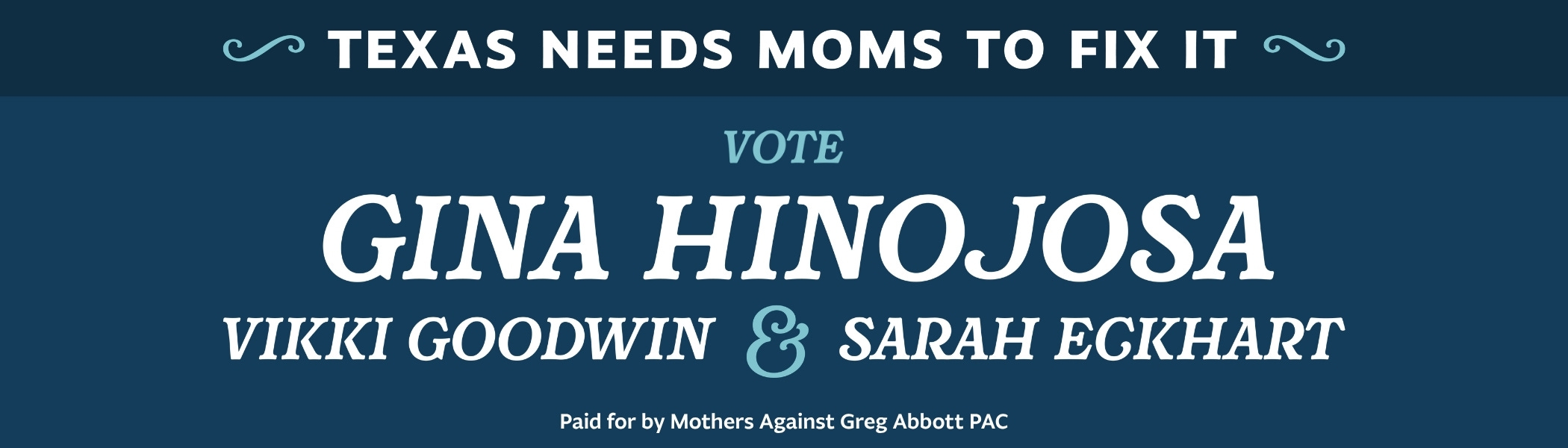
Two weeks ago, I was at the DNC meeting in Austin, and almost the minute I walked in, a rural Democrat pulled me aside. She was upset. Apparently, an influencer had posted something bashing me for buying billboards, saying billboards don’t work and telling people not to donate to PACs that spend money on them.
I hadn’t seen the post, and frankly, people are allowed to disagree about campaign strategy. God knows Democrats have turned disagreeing about campaign strategy into an Olympic sport. But what struck me wasn’t the criticism. It was how upset this rural Democrat was. She looked at me and essentially said, “Doesn’t she understand what those billboards mean to us?”
And there it was.
Because a billboard in Ft. Worth is advertising. A Democratic billboard in rural Texas can be something entirely different. It can say: You are not alone.
The first billboard I ever bought was in 1995 for a Dell Computer campaign. So I’ve been doing this for a while. When Mothers Against Greg Abbott started buying political billboards in 2022, however, I was a little rusty. Luckily, I had creative agency friends who knew exactly what they were doing, and together we launched more than 60 billboards across Texas during the 2022 campaign season.
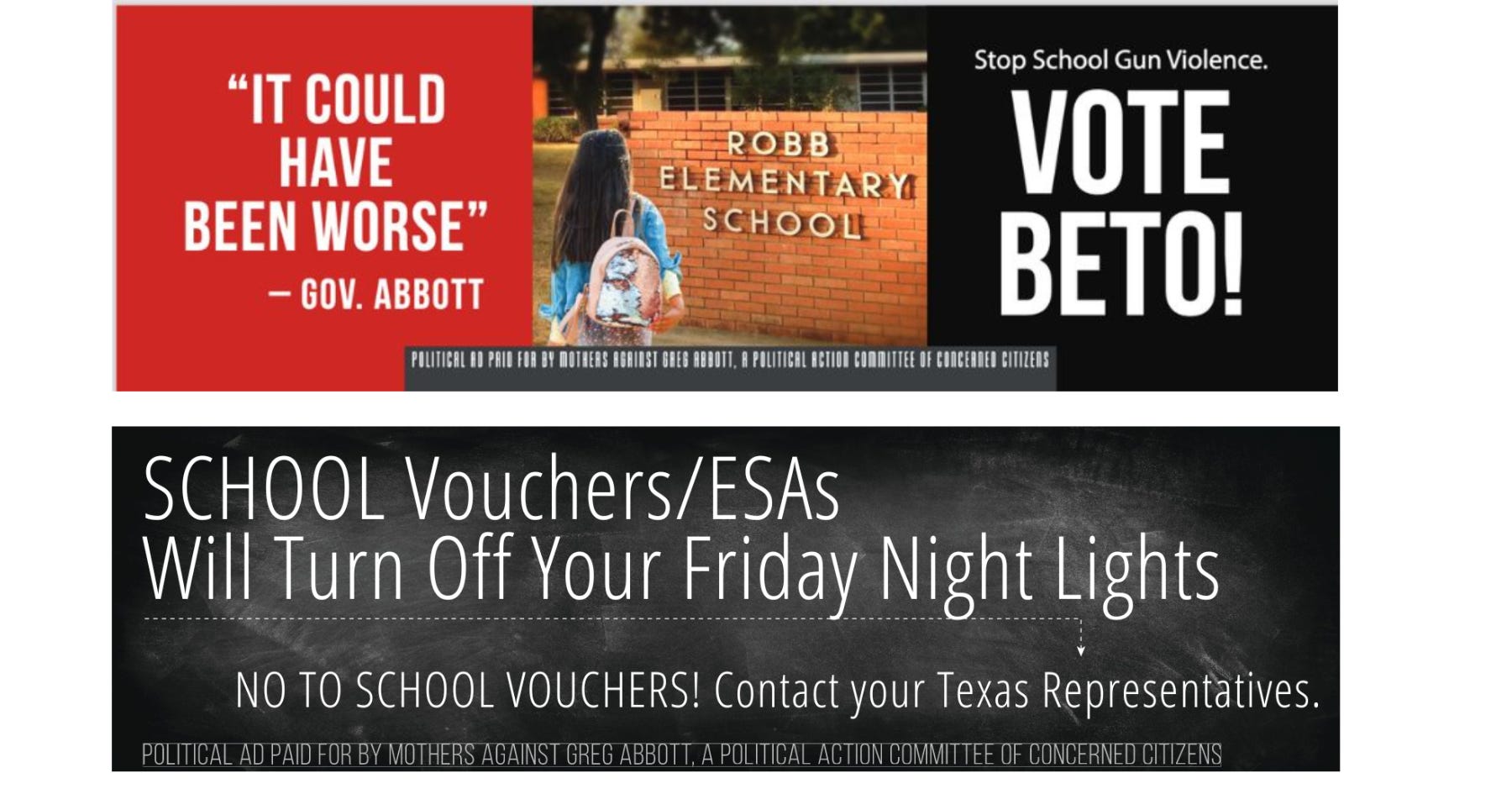
We didn’t just throw random messages on giant rectangles and hope democracy happened. We thought about locations, traffic, audiences, messages, and candidates. We learned pretty quickly that people noticed them. Candidates noticed. Volunteers noticed. Republicans definitely noticed. But most importantly, Democrats living in communities where they rarely saw anything representing them noticed.
That last part matters more than people sitting behind laptops analyzing campaign tactics sometimes understand.
Imagine being a Democrat in a Texas county where Republicans dominate almost every elected office. You drive around town and see Republican yard signs, Republican flags, Republican bumper stickers, Republican candidates and Republican messaging. Then one morning you’re driving to work and suddenly there it is: a giant Democratic message.
Maybe it’s the face and name of a local Democratic candidate. Maybe it’s about public schools. Maybe it’s about protecting water. Maybe it simply says, “Texans Over Billionaires. Vote Democrat.”
For someone in Austin, Houston or Dallas, that may just be another political advertisement. For someone who thought they were one of twelve Democrats left in their county, it can feel like somebody planted a flag.
We’re here. We see you. And there are more of us than you think.
That is not something you can entirely measure with a click-through rate.
One of the mistakes we make in modern politics is assuming that if something can’t immediately be tracked through a digital dashboard, it doesn’t have value. How many people clicked? How many emails did we collect? How many donations came directly from it? Those are useful measurements, but campaigns also spend enormous amounts of money building something much harder to quantify: familiarity.
A voter sees a candidate’s name on a billboard Monday. They see the candidate’s social media ad Wednesday. A mailer arrives Friday. They see a yard sign Saturday. Then they walk into the voting booth and see that name again.
Suddenly that candidate isn’t a stranger.
That’s advertising. Billboards aren’t supposed to close the sale all by themselves. They’re part of the drumbeat.
There is also the tiny geographical detail that Texas is freaking huge. We have 254 counties, rural communities, small towns, highways stretching hundreds of miles and voters who aren’t perpetually online. Political strategy in Texas cannot be designed as though everyone lives in a densely populated neighborhood with high-speed internet and spends six hours a day scrolling Instagram.
You know what Texans do have?
Roads. Lots and lots of roads.
And we spend a ridiculous amount of time driving on them.
That’s one reason outdoor advertising can be particularly useful in communities where campaigns struggle to reach people through traditional Democratic channels. A billboard doesn’t require someone to follow your account. It doesn’t care about an algorithm. It doesn’t land in a spam folder. Nobody can hit “Skip Ad.” Nobody can scroll past it. And it doesn’t disappear because a billionaire woke up one morning and decided to change the social media algorithm again.
It just stands there. Twenty-four hours a day, seven days a week, doing its job.
Billboards are particularly good at doing a few simple things repeatedly. They build candidate name and face recognition, especially for down-ballot candidates who don’t have millions of dollars to introduce themselves. They reinforce messages voters may already be seeing on television, through mail, online or at their doors. They work beautifully for simple reminders like “Early Voting Starts Monday,” “Vote All the Way Down the Ballot,” or “Texans Over Billionaires.” They can introduce an issue, establish a campaign’s presence in a community and create repeated impressions among commuters who travel the same roads every day.
Digital billboards give us even more flexibility because messages can be changed quickly. A campaign can highlight a candidate, switch to an early-voting message and then move into a final GOTV message without replacing an entire physical board.
There is another benefit people rarely talk about: candidates freaking love their billboards.
And I love watching them see one for the first time! They take pictures underneath them. Their volunteers take pictures. Supporters share them online. County parties post them. People text pictures to their friends. Suddenly one billboard becomes social media content, fundraising content, volunteer content and earned attention.
It’s an instant candidate glow-up.
But there is something deeper happening too. Imagine running as a Democrat somewhere Republicans have dominated for decades. You’re knocking doors. You’re raising $25 at a time. You’re attending county fairs and candidate forums. You’re putting hundreds of miles on your car. You’re doing events where six people show up and three of them are related to you.
Then one morning you drive down the highway.
And there is your face.
Twenty feet tall.
Someone invested in you. Someone believes your race matters. Someone believes Democrats should compete in your community.
Tell me that doesn’t put a little gas back in the tank.
I called a candidate after we posted a billboard with their name and send them a photo and they called me with tears in their eyes. I told this candidate, “I just want you to know I see you and how hard you are working.”
Republicans are doing it!
And here’s the part of the anti-billboard argument that always makes me laugh: Republicans use billboards too. They have for decades. Political campaigns, corporations, hospitals, universities, lawyers, restaurants and basically every Buc-ee’s within 400 miles use outdoor advertising for the same fundamental reason.
Repeated exposure builds familiarity.
So asking, “Do billboards work?” is actually the wrong question.
The better question is: What are we trying to accomplish, who are we trying to reach, and is a billboard a good tool for that particular job?
Sometimes the answer will be no. Sometimes digital advertising makes more sense. Sometimes mail does. Sometimes television, texting or canvassing is the better investment. But in a state as geographically enormous and politically diverse as Texas, declaring an entire communications medium useless is silly.
And this is ultimately why that conversation at the DNC meeting stayed with me.
Political professionals tend to talk about voters as numbers. Persuasion universes. Turnout scores. Impressions. CPM. Precinct performance. All of that matters. I use data too.
But voters are human beings.
And human beings want to know they belong to something.
When Democrats disappear from rural communities, we shouldn’t be surprised when voters conclude Democrats don’t exist there. You cannot rebuild a party in places where the party is invisible.
That doesn’t mean putting up a billboard and declaring Mission Accomplished. It means showing up. It means knocking doors, running candidates, holding events, rebuilding county parties, talking about local issues, supporting organizers and giving people something they can participate in.
And yes, sometimes it means putting up a gigantic freaking sign next to the highway that says:
WE’RE HERE.
Billboards don’t replace organizing. They amplify it.
I would never tell a campaign, “Forget field. Forget volunteers. Forget digital. Forget mail. Just buy a billboard.” That would be ridiculous. Billboards are one tool in a much larger toolbox.
But Democrats aren’t exactly suffering from too much visibility in rural Texas. Quite the opposite.
For years, we’ve talked about rebuilding Democratic infrastructure outside the major cities. Well, infrastructure begins with presence. People need to see us. Candidates need to know someone has their backs. Volunteers need to feel like they’re part of something bigger. And voters need to know they aren’t the only Democrat driving down that highway.
So yes, we’re going to keep organizing. We’re going to keep knocking doors. We’re going to keep making videos. We’re going to keep training candidates. We’re going to keep talking to voters.
And every once in a while, we’re also going to put our message on a giant sign beside a Texas highway.
Because sometimes democracy needs a conversation.
And sometimes? Democracy needs a 48-foot billboard.
If you want to DONATE To Billboards across Texas, you can donate here: https://secure.actblue.com/donate/momsbillboards?refcode=Substack
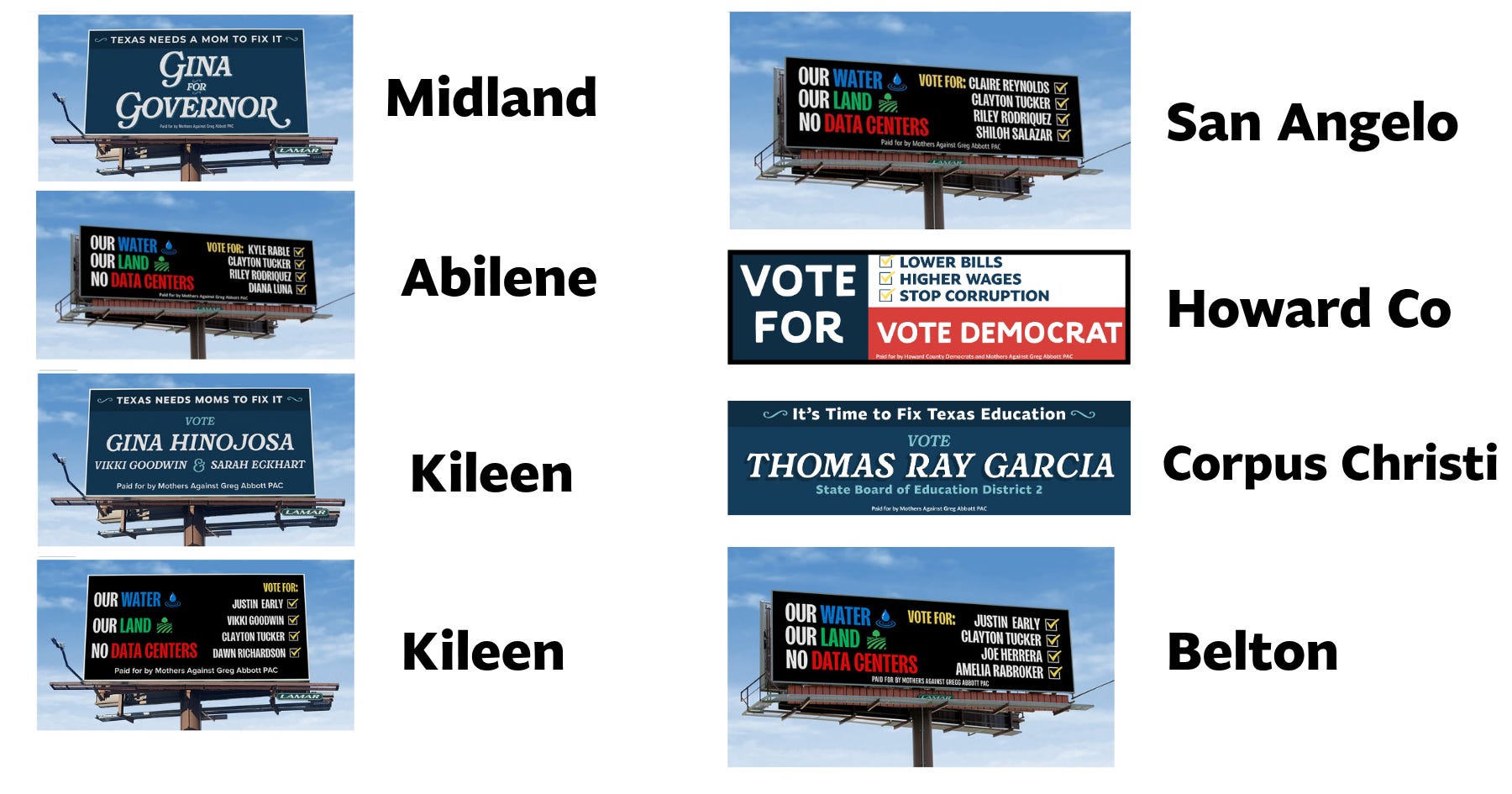
Here’s where we currently have billboards:
My tips on buying Billboards:
Most billboard companies are owned by Republicans, so first check to see who will work with you.
Digital Billboards are the most flexible. You can change the images easily, and you don’t have to pay for a vinyl-printed billboard. You can also negotiate. I was able to run my billboard on every digital billboard in one town for less than if it stayed on just one billboard.
Ask for deals. You never know when they'll say YES.
If you do print a vinyl, you should be able to reuse your vinyl on another board. Ask the billboard company.
Think strategically: where do you need name recognition? What areas can you turn blue or purple? Where is the location? Is there a stop light? What side of the street is the billboard on? What’s the traffic pattern? Does the candidate match the messaging for that area?
Yours in resistance,
Nancy Thompson
As one of those candidates she's talking about, you have no idea what those billboards mean to people around here. My voters stop and take pictures with them and send them to me. Because it's their billboard too!
The Texas Red Wall is Crumbling!