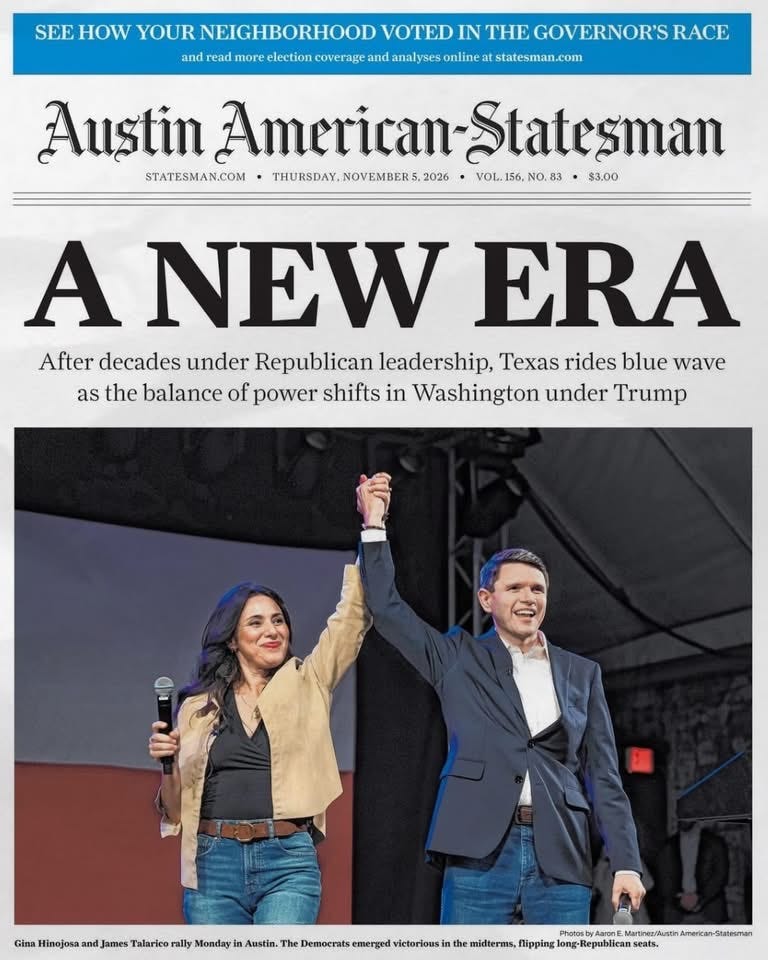
We did it! We turned Texas BLUE, but what exactly happened?
Gina Hinojosa beat Greg Abbott and will become the first Latina governor in Texas history. James Talarico beat Ken Paxton for the U.S. Senate.
First, let’s talk about what the Republicans did wrong. In September 2025, I wrote about a talk Greg Abbott’s strategist, Dave Carney, gave at a political consultants’ conference. He laid out how Republicans planned to win in Texas. They would bring younger voters into the party, invest in South Texas, hammer Democrats on crime, and keep their candidates focused on what voters cared about. And a big part of the plan depended on Black and Latino Texans staying home. But Texans showed up!
So let’s go back through the playbook. Read my original piece on Dave Carney’s strategy. Associated Press election coverage.
1. A crowd is easy to photograph. A voter takes follow-up.
Carney talked about using Charlie Kirk memorial events to register young voters and bring down the average age of the Republican electorate. Turning Point USA could get attention, fill a room, and keep clips circulating for days. Then came the harder part. Who would follow up with those students? Who could give them a reason to vote for Ken Paxton? What was he offering a 19-year-old trying to figure out how to pay rent and stay in school?
On our side, people were registering young voters and talking to them about the election they were actually going to vote in. That meant answering basic questions about where to vote and talking about the races below the top of the ticket. It takes more time than filming a clip. It also gives a first-time voter somebody to call when they have a question.
2. When the math finally maths
Carney’s plan counted on Black and Latino Texans sitting out. Democrats and grassroots groups had to earn those votes, too. That meant making time for conversations, listening to what people were angry about, and investing in communities campaigns have too often treated as a last-minute turnout assignment.
The Houston Chronicle found that turnout rose sharply in parts of South Texas and that a shift among Latino voters helped Democrats win statewide. In Houston’s East End, there was a more personal picture of what brought some voters to the polls. During early voting, Ronaldo Salgado put his “I Voted” sticker on the memorial for his father, Lorenzo Salgado Araujo, who was shot and killed by an ICE agent in July. Other voters followed. The stickers accumulated alongside flowers, candles, and flags. People wanted that family and their neighbors to know they had shown up. Houston Chronicle turnout analysis. Houston Chronicle reporting from the memorial.
3. Message, Money, Messenger
Carney’s three ingredients were message, money, and messenger. Republicans had money to put their candidates in front of Texans again and again. That meant Texans had plenty of time to decide how they felt about Greg Abbott and Ken Paxton. And their war chests put hundreds of thousands into down-ballot candidates.
Democrats made the choice concrete. When Abbott talked about affordability, we asked what had happened to the bills Texans actually pay after more than a decade with him in office. When Republicans talked about education, we talked about the public schools our children attend and the decisions lawmakers had made about funding them. We defined the people in power by what they had done with it. Early enough for voters to hear that case before the attack ads piled up.
4. Carney gave good advice. His party should have taken it.
Carney said voters cared about jobs, the cost of living, and safety. He thought Democrats would get sidetracked by culture-war fights. Republicans spent plenty of the campaign picking those fights themselves. And it sure didn’t help that Trump waged a war in Iran that increased inflation, the price of gas and diesel, and the prices at the grocery store. Republicans seemed out of touch with the real pain of Texans while they were trying to blame the border or trans people for our problems, especially when the problem was President Trump.
Democrats kept coming back to affordability, public schools, and taxes. How much does it cost to live here? Can your school keep good teachers? What are you getting for what you pay? If a campaign has answered those questions so many times that its own staff is sick of hearing the answers, good. The parent who finally got a chance to sit down after putting the kids to bed may be hearing them for the first time.
5. County organizers had a head start on the cavalry
Carney talked about investing in South Texas and building power down ballot. He was right about the value of that work. By the end of the campaign, the fight to elect Paxton was drawing national attention. Meanwhile, local organizers had been doing the daily work of finding voters, answering questions, and getting people to the polls.
We started on the 2026 election two years ago, and most of us weren’t waiting for permission. I watched county chairs and volunteers get on with it, while the bigger organizations (TDP, TMP, Texas Together) were still figuring out who was doing what. When they finally decided on a plan, the rest were looking at them thinking, “Where the hell have you people been?” Some groups worked together. Some ran their own programs. Down-ballot candidates gave people a reason to turn out in places statewide campaigns could easily overlook.
People shared what they could, took responsibility for the work in front of them, and quit waiting for someone to hand them a plan. The counties that just turned blue waited for NO ONE to come save them. NO ONE! A national campaign can buy another ad tomorrow. A county chair has to spend years becoming someone their neighbors will pick up the phone for. And our volunteers were the best! Did I mention most of us were already doing the work by the time the Texas Together folks reached out 3 weeks before election day! JFC…I kid you not! While I will say this campaign was 110% better coordinated than 2024, we have a while to go yet. I’ll save that for another post.
6. Texans get to decide what safety means
Republicans wanted the conversation about safety to center on crime and bail. Families in Houston’s East End had their own questions. What does safety mean when a federal agent kills a father in your neighborhood? Who answers to his family? Who listens to the people who have to walk past the spot where he died?
Those questions belong in any conversation about public safety. If you ask Texans to trust you with the power to enforce the law, they get to ask how you’ll hold the people who wield that power accountable.
7. Vouchers brought moms together across party lines
I’ve talked to Republican moms and Democratic moms who disagree on plenty and can still have the same conversation about their public school. They know the teacher who buys supplies out of her own paycheck. They know what happens when the district cuts a bus route. They know how far they’d have to drive to get to a private school, assuming there’s one nearby that will take their kid.
Republicans could call vouchers “education savings accounts” all day. Parents wanted to know what would happen to the school their kids already attended. That question brought people into the same room who might never have gone to the same political meeting. We should remember that the next time someone tells us a county is too red to organize in.
8. Young people can hear the contradiction
Carney was right about one thing on campus outreach. If you want young people to take you seriously, you have to show up and be willing to hear what they think. Republicans wanted to look like the party where young people belonged while picking fights over the rights of LGBTQ Texans. Students could hear both messages. Plenty of students had friends, classmates, and family members who were living with the consequences of those fights. It’s hard to say you are the party of youth when the average age of a Republican is 68.5 years old.
Democrats have to keep showing up between elections, too. If we want young people to build a life in Texas, we ought to be able to talk to them about rent, jobs, and whether they’ll have the freedom to live that life here. And we ought to give them a say in what we do about it. This election belonged to Millennials and Gen Z voters, and I am okay with that.
History repeating
It was absolutely wild to see Republicans acting like Democrats this election cycle. For the first time in years, we saw Republicans asking people to vote, to vote early, to register to vote, to stay in line. Things that normally Democrats would say. And they were all taking pictures of themselves using Greg Abbott’s App! Yep, we did that one too, in 2022. The App is not the same as knocking on doors. It was an excuse to not talk to people up close.
Democrats finally started knocking on doors. It made a huge difference. HUGE!
Question for Republicans
So Republicans, DO YOU GET IT NOW? Do you get why we need to expand voting rights? Because your rules are hurting YOUR OWN voters. At some point, you were hurting yourselves. Want young people to vote for you? Make it easier. Hell, want old people to vote for you? Make it easier.
We won. Now it’s time to deliver.
What did we do right? We stayed on message and made Republicans answer for their records. We registered young voters. We put time and effort into reaching Black and Latino Texans. County chairs, candidates, and grassroots groups built their own turnout plans. Not many of us counted on a coordinated campaign to save us. We coordinated on our own. Many counties and candidates were not willing to let this moment pass without a good fight.
And now, it’s time to deliver for Texans. We need to pass things that Texans can feel immediate relief:
Temporary hold on the gas tax till the economy improves
Funding for public schools
State funding for local government and mandates so we can lower taxes
Expand Medicaid, so our rural hospitals don’t close
Increase the minimum wage
Pass new voter protection and election laws
Insurance for kids
Free lunch for public school kids.
And so much more
Let’s keep riding that Blue Wave,
Love
Nancy Thompson
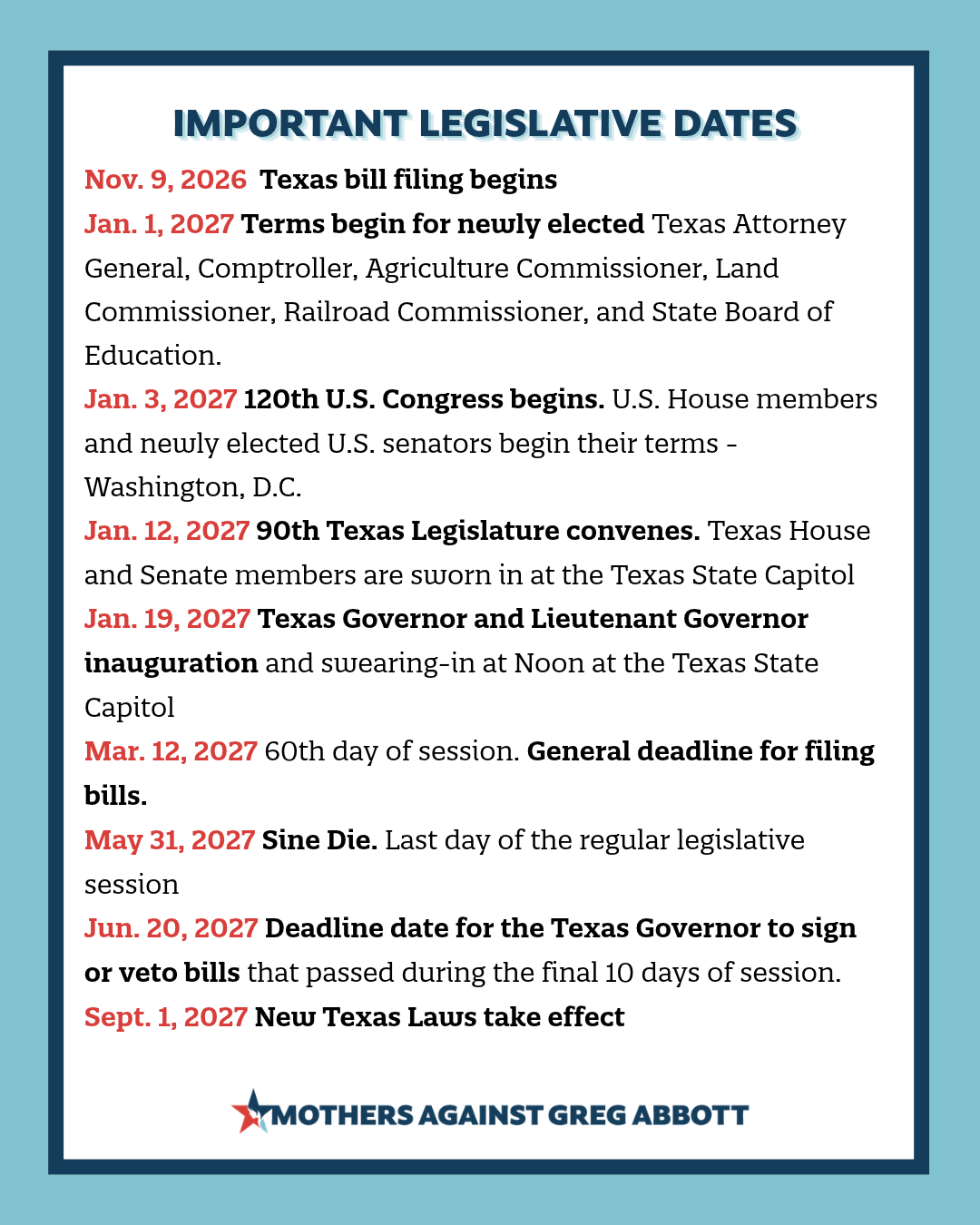
PS> Here are some Legislative Dates for you to keep track of